Exhibition · Installation · Picturebook
The Big Bad Wolf
with a Toothache
A walk-in picturebook in which the reader enters the wolf’s mouth.
An immersive exhibition based on Daniel Kondo’s Lobo Mau com Dor de Dente, transforming the physical logic of the book into architecture, movement and participation.
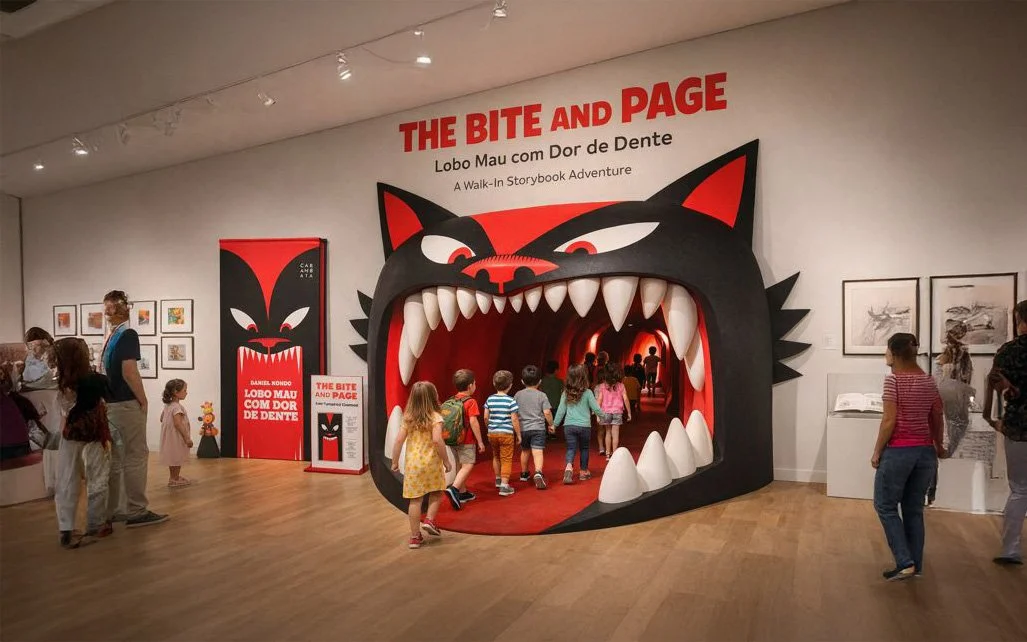
Exhibition concept
The page turn becomes a place.
The installation translates the mechanics of a picturebook into physical space. Sequence becomes movement. Scale changes around the visitor. Pauses, repetition and anticipation become part of the route through the exhibition.
In the original book, the reader turns a vertical volume from bottom to top. As the story progresses, the object itself gradually becomes the wolf’s open mouth.
The exhibition enlarges that gesture. Children enter the mouth, cross sequences derived from the spreads and experience the rhythm of reading with their own bodies.
Visitor experience
Reading by walking.
Cover / Threshold
A large-scale cover marks the entrance and introduces the exhibition as a book that can be entered.
The Mouth
Visitors pass through the wolf’s mouth. Teeth become sculptural elements, seats, frames and portals scaled to a child’s body.
Page-Turn Corridor
Oversized spreads create a sequence of spaces. Walking through them reproduces the rhythm, interruption and surprise created by turning pages.
Toothache Pause
The pace slows. Sound, scale and repetition turn waiting, irritation and comic suspense into physical experience.
The Reader Enters the Story
Children can become dentist, narrator or wolf through simple interactions involving voice, touch, drawing and role play.
Exit
The visitor leaves the installation and returns to the book, now carrying the memory of having physically inhabited its sequence.
Installation
Built from the grammar of the book.
Sculptural wolf mouth
Soft materials, rounded forms and child-scale architectural elements.
Large-scale spreads
Modular reproductions translating sequential illustration into walls and spatial cuts.
Sound
Breath, chewing, tooth-throb rhythms, silence and page-turn cues can punctuate the visitor’s route.
Participation
Simple activities involving storytelling, drawing, performance and play.
Original material
Sketches, dummy books, layouts and process material can connect the installation to picturebook practice.
Modular construction
The project can be adapted to different museums, cultural centres, libraries and exhibition spaces.
The original book
The exhibition begins with a book-object.
Lobo Mau com Dor de Dente was written, illustrated and designed by Daniel Kondo and published in Brazil by Carambaia in 2024.
Its unusual vertical format makes handling part of the story: page by page, the book gradually assumes the shape of the Big Bad Wolf’s mouth.
The work has received recognition across illustration, literature and editorial design.
Full book page →Project materials
Exhibition material available.
About
Daniel Kondo
Author · Illustrator
Book Designer
Daniel Kondo is a Brazilian author, illustrator and book designer working with picturebooks, visual narratives and editorial form.
His work explores how image, sequence, scale, typography, material and page turning participate in storytelling. His books have received recognition from literary, illustration and design institutions in Brazil and abroad.
Biography & authority records →Exhibition enquiries
Bring the wolf inside.
The installation can be adapted for museums, cultural centres, libraries, festivals and institutions working with children, books, illustration and visual culture.
comunica@kondoestudio.com →